Cauldron Women’s Labor System
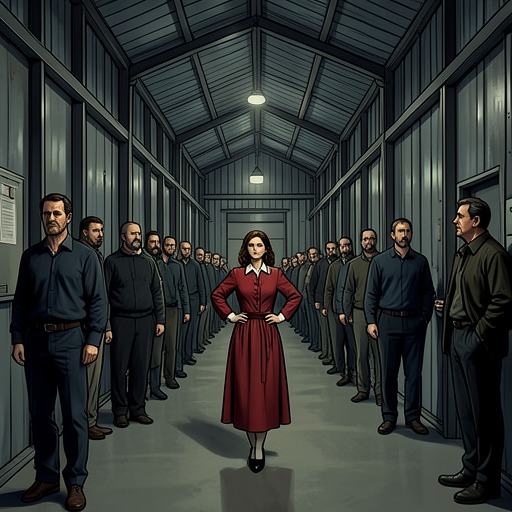
Gang Up: A Bikerland NovelThe Cauldron Women’s Labor System combines specialized, scheduled work with rules governing men’s claims on women. Abigail’s discovery that even weapons maintenance is divided into fixed tasks overturns her first impression of Brall’s road-worn followers: their rough appearance conceals an organization built around discipline and efficiency.
Work and Division of Labor
Women in the Cauldron are responsible for maintaining, repairing, and cleaning weapons, vehicles, and structures. Their jobs are divided narrowly rather than performed as interchangeable chores: one woman might clean and polish guns, another adjust barrels or sights, while another tends a different kind of firearm. The tasks are specified in advance, and efficiency takes precedence in how the work is arranged.
This work resembles, but is not identical to, women’s duties in the Family. There, women are expected to maintain homes and prepare them as safe, orderly havens for returning riders. The Family’s Matron, Sandra, also oversees women’s place in domestic life and decides whether a woman may marry into the group. The comparison shows two systems assigning women responsibility for sustaining male life and activity, while the Cauldron makes that service more explicitly regimented across its material infrastructure.
Sexual Claims and Interrupted Work
The labor system operates alongside a broad presumption of sexual access: a woman appears to belong to any man unless she is explicitly told otherwise. A rider who claims a woman for himself must give up extra shares from looting, raids, or legitimate transactions, compensating his fellow riders for what they lose when her availability is no longer shared. Sexual access is thus connected to the distribution of material rewards, not treated as separate from the group’s economy.
A woman summoned by a rider leaves her assigned task where it stands and returns to it afterward. The interruption does not erase the work schedule; it is absorbed into it. Abigail observes that women resume their tasks with a pleasant manner, understanding their labor as helping the men perform their roles. The account presents a system in which women’s work and sexual availability are both organized around riders’ needs, even as the former is divided into precise, practical assignments.
Discipline and Organization
Abigail is surprised by the Cauldron’s order because Brall and his companions initially seem unlikely to thrive under discipline. Yet the work routines match the command structure she sees around Brall: maps lie open on a table, held in place by stones, as he and his lieutenants confer. The contrast between a road-worn exterior and an orderly internal system makes discipline a defining feature of the group rather than an incidental feature of its labor.
The Cauldron’s later agreement with the Family also places women within the terms of political and material exchange. When the Cauldron is in Temple, its members are promised access to the Compound’s supplies and lodgings, with drink, women, and sleep provided free while other things must be paid for. The agreement does not describe a change to women’s assigned work, but it makes plain that women’s availability is counted among the benefits offered to the riders. The labor system therefore belongs to a wider order in which women sustain the group through work and are also treated as part of the rewards and claims structured around its men.